
Determining your value in the creator economy can feel like trying to hit a moving target while blindfolded. In 2026, the sponsorship landscape has shifted away from simple follower counts toward a complex blend of engagement quality, platform-specific reach, and production value.
If you undercharge, you leave money on the table; if you overcharge, you risk losing long-term brand partnerships. This guide—and my complete Roadmap for Brand Sponsorships—provides the clarity you need to price with confidence and build a sustainable business.
Table of Contents
- The Golden Rule: You Are the Boss of Your Rates
- The Core Pricing Models in 2026
- YouTube Sponsorship Rates: The Gold Standard
- TikTok and Instagram: Pricing Short-Form Content
- The 2026 Sponsorship Rate Calculator Table
- Case Study: The Anatomy of a $5,000 Deal
- Factors That Justify a Premium Rate
- The “Hidden” Costs of Being a Creator
- The Negotiation Playbook
- Common Mistakes to Avoid When Pricing
- Frequently Asked Questions (FAQ)
- Summary and Next Steps
The Golden Rule: You Are the Boss of Your Rates
Before we dive into the hard data, there is one thing you must understand. Ultimately, the price of your work is entirely up to you. While this guide provides industry benchmarks and “typical” guidelines based on 2026 data, you have the final say. Specifically, you can price your services at whatever level you feel is fair for your time, talent, and access to your audience.
In other words, do not feel trapped by a spreadsheet. If you feel a specific project requires more effort than the “standard” rate covers, raise your price. Consequently, you shouldn’t feel guilty for asking for what you are worth. Conversely, if you truly love a brand and want to build a long-term relationship, you might choose to be more flexible initially. Use these numbers as a map, not a cage.
The Core Pricing Models in 2026
In 2026, brands are smarter than ever about where their money goes. Therefore, you need to understand the three primary ways they calculate what they are willing to pay. According to the 2026 Influencer Marketing Hub Trends Report, data transparency is now the number one priority for brand managers.
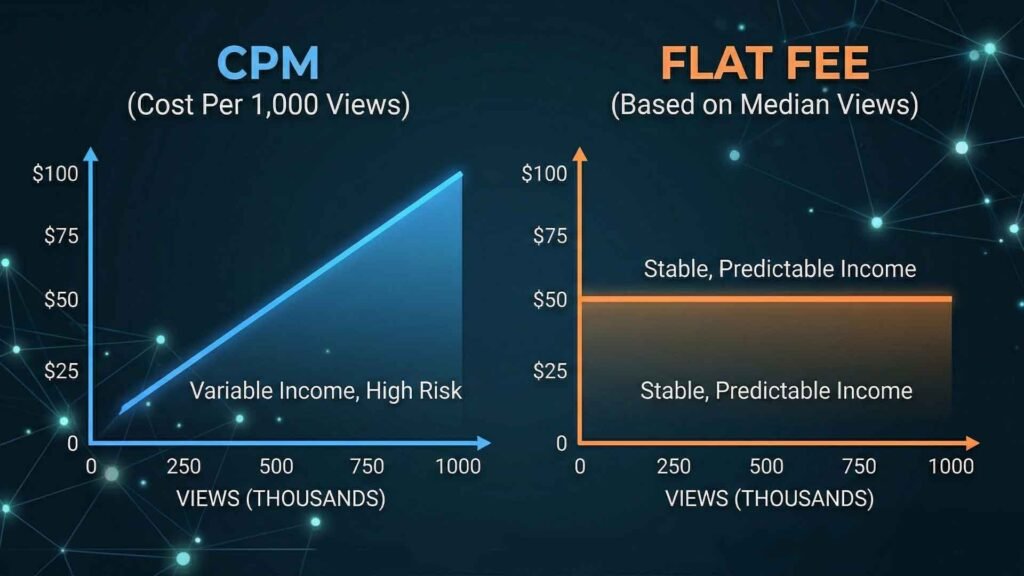
1. CPM (Cost Per Mille)
CPM is the most common model, especially on YouTube. “Mille” is Latin for thousand, so this is the cost per 1,000 views. In 2026, average YouTube CPMs range from $15 to $35. However, high-intent niches like Finance, Real Estate, or B2B Software can see CPMs as high as $70 to $100. Consequently, a video with 10,000 views in a high-CPM niche might earn more than a video with 50,000 views in a lifestyle niche.
2. Flat Fee
Many creators prefer a flat fee for the security it provides. This is usually calculated based on your average views over the last 10–20 videos, rather than your total subscriber count. This approach protects you if a video underperforms due to the algorithm. Specifically, it allows you to predict your monthly income with much higher accuracy.
3. Performance-Based (CPA)
Cost Per Acquisition (CPA) means you get paid based on the actual sales or sign-ups you generate. While riskier, this model can be incredibly lucrative for creators with high-converting audiences. Most modern deals in 2026 are “Hybrid” models. Therefore, they combine a base flat fee with a performance bonus for every sale made.
YouTube Sponsorship Rates: The Gold Standard
YouTube remains the premium platform for sponsors because of its evergreen nature. Specifically, a video you post today can still drive sales three years from now. This longevity is why YouTube rates are consistently higher than TikTok or Instagram.
Pricing by Creator Tier
Based on current 2026 benchmarks, here is what you should typically charge per integrated mention (60–90 seconds):
- Nano-Creators (1K–10K subs): $100 – $600 per video.
- Micro-Creators (10K–100K subs): $600 – $6,000 per video.
- Mid-Tier Creators (100K–500K subs): $6,000 – $18,000 per video.
- Macro-Creators (500K–1M subs): $18,000 – $60,000 per video.
- Mega-Creators (1M+ subs): $60,000+ per video.
The “Niche Premium”
Furthermore, your niche significantly impacts your “floor” price. For example, a tech reviewer with 50,000 subscribers might charge double what a lifestyle vlogger with the same audience charges. This is because the tech audience is actively looking to spend money on specific products. Consequently, your “conversion intent” is much higher.
Pro Tip: If you want to dive deeper into the specific mechanics of landing these deals, check out our guide on how to land YouTube sponsorships.
TikTok and Instagram: Pricing Short-Form Content
Short-form content pricing is more volatile because of the “viral factor.” For instance, a TikTok might get 2,000 views or 2 million views. This makes it harder for brands to predict their return on investment. Furthermore, the shelf-life of a Reel or TikTok is much shorter than a YouTube video.
Instagram Pricing in 2026
- Reels: These command the highest rates on Instagram. Expect to charge 30%–50% more for a Reel than a static post because of the production time involved.
- Stories: These are usually priced at 20%–30% of your Reel rate. They are excellent “add-ons” to larger packages. Specifically, they are great for driving direct link clicks.
- Carousel Posts: In 2026, these are highly valued because they keep users on the app longer.
TikTok Pricing in 2026
On TikTok, brands are increasingly paying for usage rights. Because organic reach can be inconsistent, brands want the right to use your video as a “Spark Ad.” Consequently, you should charge a base fee for the post plus a monthly fee (e.g., $250/month) for the brand to use your likeness in their advertising. Therefore, your “post fee” is just the beginning of the transaction.
The 2026 Sponsorship Rate Calculator Table
Use the table below as a quick-reference guide for your base rates. Remember, these are “typical” guidelines—you are free to adjust based on your unique value.
| Platform | Creator Tier | Audience Size | Typical Base Rate (USD) | 2026 Engagement Target |
| YouTube | Nano | 1K – 10K | $100 – $600 | 5% – 10% |
| YouTube | Micro | 10K – 100K | $600 – $6,000 | 3% – 7% |
| YouTube | Mid-Tier | 100K – 500K | $6,000 – $18,000 | 2% – 5% |
| Nano | 1K – 10K | $150 – $400 (Reel) | 4% – 8% | |
| Micro | 10K – 50K | $400 – $2,500 (Reel) | 2% – 5% | |
| TikTok | Nano | 1K – 10K | $50 – $300 | 7% – 15% |
| TikTok | Micro | 10K – 50K | $300 – $1,500 | 5% – 12% |
Case Study: The Anatomy of a $5,000 Deal
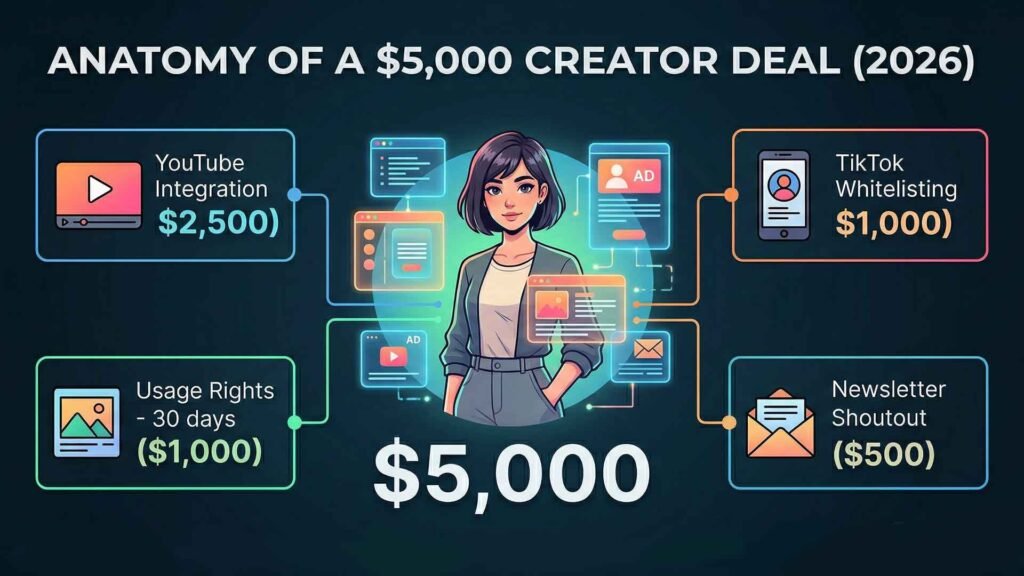
To see how these numbers work in the real world, let’s look at a hypothetical creator named Alex. Alex runs a productivity channel with 45,000 average views per video. In early 2026, a software brand approached Alex for a multi-platform integration.
Instead of just accepting a small flat fee, Alex used a “Hybrid-Value” approach to build the following package:
- YouTube Integrated Mention: Alex charged a base fee of $2,500 (roughly a $55 CPM for his niche).
- 30-Day Usage Rights: The brand wanted to use Alex’s video in their social media ads. Alex charged a $1,000 premium for this.
- Whitelisting: Alex allowed the brand to run Spark Ads from his TikTok handle for 30 days. This added $1,000 to the total.
- Newsletter Shoutout: Alex included a mention in his weekly newsletter for $500.
The Final Total: $5,000.
Specifically, Alex didn’t have 1 million subscribers, but he understood his value. By bundling “Add-ons” like usage rights and whitelisting, he doubled his initial $2,500 fee. Consequently, Alex worked smarter, not harder.
Factors That Justify a Premium Rate
Don’t just stick to the averages. If you provide extra value, you should definitely charge for it. In addition to your reach, consider these “premium levers” that professional creators use in 2026:
- Usage Rights: If a brand wants to use your video in their Facebook ads or on their website, you should charge a 20%–50% premium. This is because they are using your “social proof” to make money elsewhere.
- Exclusivity: If a brand asks you not to work with their competitors for 30 days, you are essentially losing potential income. Therefore, you should charge an extra 15%–30% for this restriction.
- Whitelisting: This is when a brand runs ads through your account. This is a high-value service that warrants a significant fee because it uses your personal handle to sell a product.
- Production Quality: If you use professional lighting, 8K cameras, and high-end editing, you aren’t just a “creator”—you are a production studio. Reflect that in your price.
The “Hidden” Costs of Being a Creator
Many creators forget to factor in their own costs when setting prices. Consequently, they end up making less than minimum wage when you account for the hours worked. Specifically, remember to include:
- Software & Gear: Cameras, editing software (like Adobe Creative Cloud), and lighting equipment are significant investments.
- Taxes: As a business owner, you likely need to set aside 25%–30% of every check for the government. Furthermore, you must account for self-employment taxes.
- Admin Time: This includes the hours spent emailing, negotiating, and revising content. Therefore, a “one-hour video” actually takes ten hours of total work.
- Contractors: If you pay an editor or a virtual assistant, their fee must come out of the sponsorship total.
The Negotiation Playbook
Negotiation is an art form. Most brands will start with a “low-ball” offer to see if you know your worth. However, you don’t have to accept the first number they throw out. Instead, follow these steps:
- Ask for the Budget: “Do you have a specific budget range in mind for this campaign?” Specifically, let them name a price first whenever possible.
- Highlight Your Stats: Show them your engagement rate and audience demographics. Use data from Tubefilter to prove where the market is moving.
- Anchor High: If you want $1,000, ask for $1,300. This gives you “wiggle room.”
- Offer Packages: Give them three options (Bronze, Silver, Gold). This shifts the conversation from “Should we hire you?” to “Which version of you should we hire?”
If you’ve been offered a deal but aren’t sure how to counter-offer without scaring the brand away, read our deep dive on the sponsorship negotiation to master the talk.
Common Mistakes to Avoid When Pricing
1. Pricing Based on Subscribers, Not Views
Subscribers are a “vanity metric” in 2026. Ultimately, brands care about how many people actually see the content. Always use your median views from your last 10 videos as the baseline for your calculations.
2. Accepting “Product Only” Deals Too Late
Gifted products are fine when you are just starting (Nano-tier). However, once you have a consistent audience, you must transition to paid deals. Specifically, free shoes do not pay the rent. Therefore, you should always ask for a monetary fee in addition to the product.
3. Not Getting a Deposit
For larger deals, always ask for 50% upfront. This ensures that you are compensated for your production time even if the brand changes its mind later. In other words, protect your time as much as your content.
Frequently Asked Questions (FAQ)
You should always charge a Rush Fee. Specifically, a 24-48 hour turnaround usually justifies a 25%–50% premium on top of your base rate. In other words, you are being paid for the disruption to your existing content schedule.
Yes. In 2026, vertical video (Reels/Shorts) often has a higher engagement rate but a shorter shelf-life. Conversely, horizontal video (YouTube) requires more production time but offers long-term SEO value. Therefore, horizontal video should generally be priced 30% higher than vertical equivalents.
Absolutely. A dedicated 10-minute video is a massive production compared to a 60-second integration. Specifically, dedicated videos should be priced at 2x to 3x your standard integration rate.
No. This is a common tactic brands use to save money. Consequently, you should price the current project at its full value. If they want a discount for a long-term commitment, only grant it if they sign a contract for 3+ months of guaranteed work.
Summary and Next Steps
Pricing your content in 2026 requires a balance of data and confidence. By understanding your CPM, accounting for niche premiums, and charging for additional rights, you ensure that your creative career is sustainable. Ultimately, remember that you are the one in control of your business.
While these guidelines help you stay competitive, your unique voice and community are worth what you say they are. Treat yourself like the professional business owner you are.
Ready to turn your channel into a business? Subscribe to the YT Torials newsletter for weekly deep dives into creator monetization, and follow us on YouTube @yttorials for video walkthroughs of these strategies.
Related Posts
How to Sell Your First Digital Product
Create, List, and Sell: Easy Printful Tips for New Creators
How to Upload Designs to Spreadshirt
YouTube Supers: The Ultimate Guide to Fan Funding
How to Sell Without “Selling” Scripts & Templates

No responses yet