
The dream of making money while you sleep is no longer a fairy tale. In 2026, the creator economy has evolved into a massive professional industry. Specifically, digital products have become the most reliable way to escape the “views-to-paycheck” cycle. If you rely only on ad revenue, you are leaving thousands of dollars on the table. However, creating and selling your first digital product can feel overwhelming. This guide will show you exactly how to build a product that your fans love. Furthermore, it will explain how to turn your YouTube channel into a passive income machine. Indeed, you do not need a million subscribers to start. You only need a plan and a deep understanding of your audience. Therefore, let’s dive into the roadmap for your success.
Table of Contents
- Why Digital Products are Better Than Merch
- How to Validate Your Idea Without Spending Money
- 20 Profitable Digital Products for YouTubers
- Choosing Your Storefront: Platform Comparison Table
- Selling on YouTube: The Step-by-Step Strategy
- The Perfect Sales Funnel for Beginners
- Pricing Strategies: How to Not Leave Money on the Table
- Managing Taxes and Global Legal Rules
- Frequently Asked Questions
- Summary and Next Steps
Why Digital Products are Better Than Merch
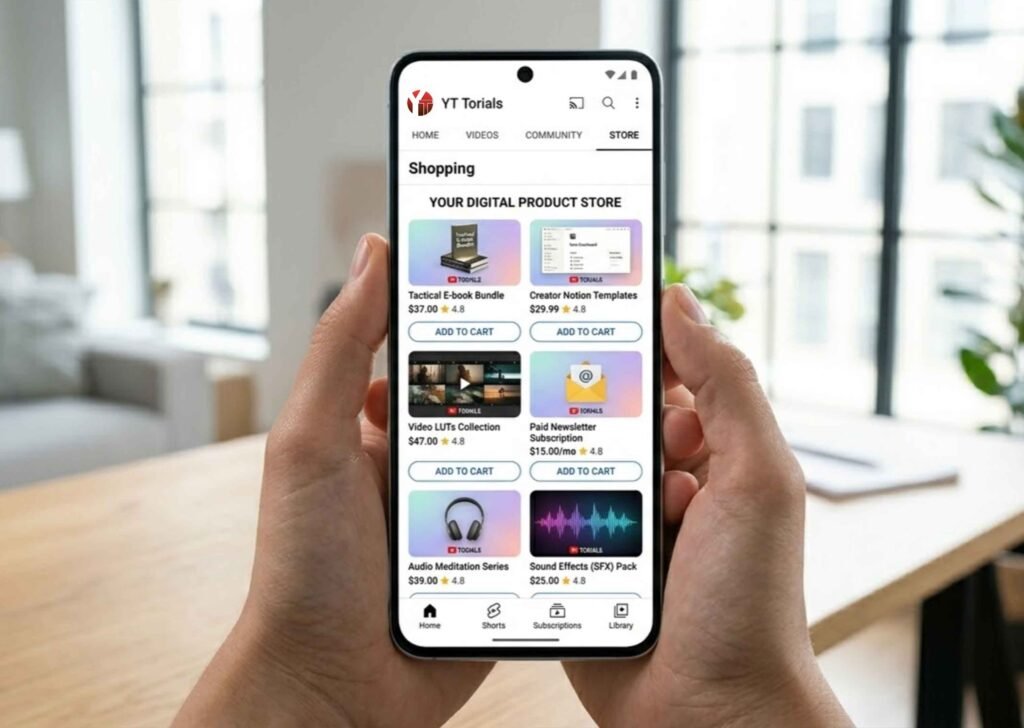
Most YouTubers start by selling t-shirts or hats. However, physical merch has many hidden costs. You have to pay for printing and shipping. Customers might return items if the size is wrong. Digital products solve these problems easily. There is no inventory to store in your house. Delivery is instant through an email link. You can reach fans in any country without paying extra for shipping. According to recent data, email marketing returns about $42 for every $1 you spend. Therefore, digital sales are much more profitable than physical goods. You keep more of the money you earn. Furthermore, you do not need to deal with customer complaints about broken items. Still, many creators ignore this opportunity. In fact, digital assets are the future of online business. Indeed, the scalability of digital files is unmatched. You spend time building it once, and then the system takes over.
- Zero Inventory: You never have to worry about unsold boxes of hoodies.
- Instant Delivery: Your customer gets their purchase the second their payment clears.
- Massive Margins: After the initial time investment, your only costs are small platform fees.
- Global Reach: You can sell to someone in Tokyo as easily as someone in Texas.
- Unlimited Stock: You can never “run out” of a PDF or a video course.
How to Validate Your Idea Without Spending Money
You should not guess what your fans want to buy. Instead, you must use data to find a winning idea. Start by looking at your top-performing videos. Specifically, look for videos where people ask for more help. If people ask the same question ten times, that is a product idea. You can also run a poll on your YouTube Community tab. Ask your fans which problem they want to solve first. For example, do they want a workout plan or a recipe book? This helps you build something that people actually need. Additionally, you should study your competitors to see what they are missing. In fact, checking your YouTube analytics is the best way to start. Likewise, look at your most liked comments for hidden clues. Otherwise, you might waste time on a product that nobody wants.
To learn more about selling without being annoying, check out our Sell Without Selling Cheat Sheet. It will help you pitch your product naturally in your videos.

20 Profitable Digital Products for YouTubers
The best digital product is one that solves a specific problem for a specific person. Here are 20 ideas to get you started.
Educational & Informational Assets
- 1. Tactical E-books: These are not 300-page novels. Specifically, they are “result-oriented” guides (20–50 pages) that solve a single problem.
- Target Audience: Beginners looking for a quick win.
- 2026 Price Point: $19 – $37.
- 2. Online Courses: A structured series of video lessons. Indeed, courses are the “High-Tier” offer of the education world.
- Target Audience: Students wanting a total transformation.
- 2026 Price Point: $99 – $997+.
- 3. Paid Newsletters: Use platforms like Substack to offer exclusive weekly insights. For example, you could share “behind-the-scenes” data or industry news.
- Target Audience: Super-fans and professionals.
- 2026 Price Point: $5 – $20/month.
- 4. Workshop Replays: Did you do a live Q&A or a deep-dive tutorial? Instead of letting it vanish, sell the recording.
- Target Audience: People who missed the live event.
- 2026 Price Point: $27 – $47.
- 5. Audio Series: These are essentially private podcasts. Also, they are great for “hands-free” learning during commutes.
- Target Audience: Busy professionals and commuters.
- 2026 Price Point: $29 – $59.
Productivity & Business Tools
- 6. Notion Templates: Pre-built workspaces for life or business. Consequently, your fans save dozens of hours on setup.
- Target Audience: Students, freelancers, and organized creators.
- 2026 Price Point: $15 – $49.
- 7. Excel/Google Sheets: Spreadsheets that do the math for the user. Still, these are the gold standard for budget and habit tracking.
- Target Audience: Finance-focused and data-driven viewers.
- 2026 Price Point: $10 – $35.
- 8. AI Prompt Libraries: Specialized “Mega-Prompts” for tools like ChatGPT or Midjourney. Indeed, this is the fastest-growing digital product category in 2026.
- Target Audience: Professionals looking to automate their work.
- 2026 Price Point: $27 – $97.
- 9. Slide Deck Templates: Branded presentation designs for Powerpoint or Canva. Furthermore, these help your audience look professional in meetings.
- Target Audience: Corporate workers and entrepreneurs.
- 2026 Price Point: $25 – $65.
- 10. Digital Planners: Interactive PDFs for iPad apps like GoodNotes. Also, these have a very loyal “aesthetic” community.
- Target Audience: Students and bullet-journal fans.
- 2026 Price Point: $15 – $30.
Creative Assets & Media
- 11. Lightroom Presets: Custom filters for photo editing. Likewise, these allow followers to get your exact “look” with one click.
- Target Audience: Aspiring photographers and Instagrammers.
- 2026 Price Point: $10 – $50 (per pack).
- 12. Video LUTs: Color-grading files for video editors. Otherwise, beginners struggle to make their footage look cinematic.
- Target Audience: New YouTubers and filmmakers.
- 2026 Price Point: $20 – $75.
- 13. Stock Footage/Photos: High-quality B-roll or photography. In addition, these are essential for other creators and small businesses.
- Target Audience: Content creators and marketing agencies.
- 2026 Price Point: $5 – $15 (per clip).
- 14. Sound Effects (SFX) Packs: Original sounds for video transitions or gaming. Thus, you help other creators improve their production value.
- Target Audience: Video editors and streamers.
- 2026 Price Point: $15 – $45.
- 15. Overlays & Transitions: Graphics like “Lower Thirds” or “Subscribe” buttons. Similarly, these provide a professional polish to any channel.
- Target Audience: New streamers and vloggers.
- 2026 Price Point: $10 – $40.
Niche-Specific Solutions
- 16. Workout Programs: 4–12 week PDF or video guides. Finally, followers have a clear path to their physical goals.
- Target Audience: Fitness enthusiasts and beginners.
- 2026 Price Point: $27 – $97.
- 17. Meal Plans & Recipe Books: Categorized diets (Keto, Vegan, etc.). In contrast, most people struggle to decide what to cook daily.
- Target Audience: Health-conscious viewers.
- 2026 Price Point: $19 – $37.
- 18. Code Snippets: Ready-to-use scripts for developers. Specifically, these help tech fans skip the “boring” parts of coding.
- Target Audience: Web developers and software engineers.
- 2026 Price Point: $20 – $99.
- 19. Sheet Music/Tabs: Notes or guitar tabs for your original songs. Meanwhile, your musical fans can learn your art correctly.
- Target Audience: Aspiring musicians.
- 2026 Price Point: $5 – $25.
- 20. Membership Communities: Access to a private Discord or Skool group. Therefore, you can provide direct support and networking to your fans.
- Target Audience: High-intent learners and networkers.
- 2026 Price Point: $29 – $199/month.
Choosing Your Storefront: Platform Comparison Table
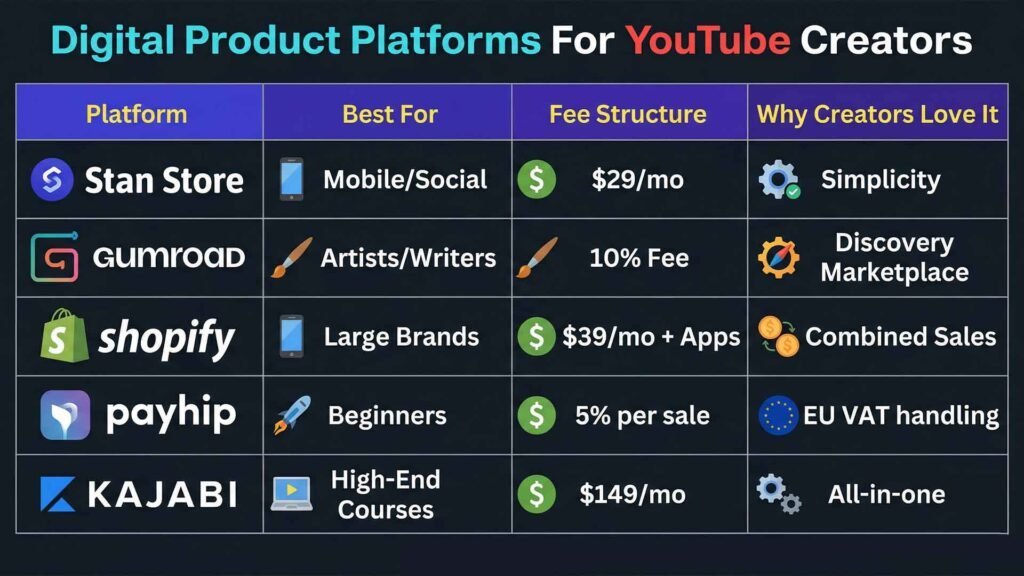
Choosing the right platform is critical for your success. In 2026, the “Merchant of Record” (MoR) model has become the gold standard. Specifically, these platforms handle global sales tax for you. However, each platform has different strengths. Therefore, use this table to find the best fit for your creator business.
| Platform | Best For | Fee Structure | Why Creators Love It |
| Stan Store | Mobile/Social | $29/mo (Flat) | Simplest “Link in Bio” setup. |
| Gumroad | Artists/Writers | 10% Flat Fee | High discovery marketplace. |
| Shopify | Large Brands | $39/mo + Apps | Best for combined digital/merch. |
| Payhip | Beginners | 5% per sale (Free) | Handles global taxes (EU VAT). |
| Kajabi | High-End Courses | $149/mo | All-in-one marketing powerhouse. |
Selling on YouTube: The Step-by-Step Strategy
YouTube has made it incredibly easy to sell directly to your viewers. You no longer have to beg people to check the link in the description. Instead, you should use the YouTube Shopping features. This allows you to tag products in your videos. When someone watches, they see a small shop icon. Consequently, they can buy without leaving the YouTube app. Also, you should mention your product in the first 60 seconds of your video. Furthermore, use your YouTube Community tab to share success stories from customers. Indeed, social proof is the fastest way to build trust. For a technical breakdown on this setup, read our guide on How to Sell Merchandise on YouTube. Specifically, the integration process for digital stores works exactly the same.
The Perfect Sales Funnel for Beginners
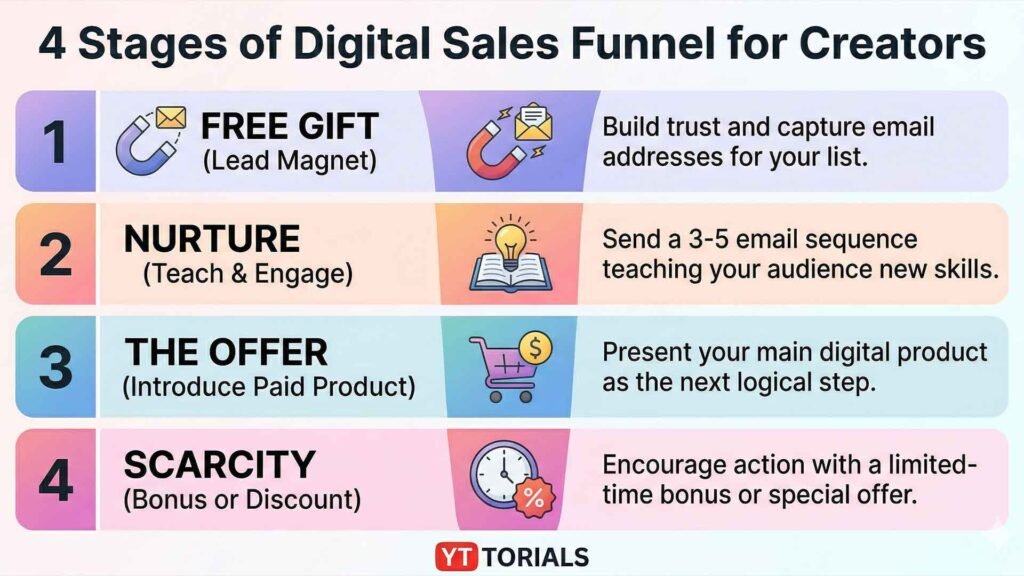
A sales funnel is simply the journey a follower takes to become a customer. Specifically, it starts with your YouTube video. First, you give away a free gift. This is called a “Lead Magnet.” It could be a simple 1-page PDF or a template. In exchange, the viewer gives you their email address. This builds a list of people who trust you. Next, you send a series of 3 to 5 emails. These emails should provide more value and then introduce your paid product. Furthermore, you should use a “Limited Time Discount” to encourage people to buy now. Indeed, most sales happen in the inbox. Therefore, building an email list is your most important task. Conversely, manual selling takes too much time. Indeed, automation is the key to freedom.
- Free Gift: Give away value to capture an email address.
- Nurture: Send 3 emails teaching something new.
- The Offer: Introduce your product as the next step.
- Scarcity: Offer a limited-time bonus or discount.

Pricing Strategies: How to Not Leave Money on the Table
Pricing is a psychological game. Specifically, you should offer a “Value Ladder.” This means having products at different price points. For example, a $7 checklist is an easy “Yes” for a new fan. Next, you can offer a $47 workbook. Furthermore, you can have a $197 masterclass. Indeed, this allows you to serve fans at every budget level. Also, you should use “Odd Number Pricing.” For instance, $27 usually sells better than $30. Moreover, always show the “Retail Value” compared to your price. If the product is worth $500 but you sell it for $97, people feel like they are getting a deal. Consequently, your conversion rate will go up. Still, remember to keep your pricing fair for your niche.
Managing Taxes and Global Legal Rules
Selling digital products across the world can be tricky. Many countries have sales tax laws for digital goods. However, you can use a Merchant of Record to handle this. Services like Lemon Squeezy or Payhip act as the seller for you. They collect the tax from the customer. Then they pay it to the government. This keeps you safe from legal trouble. You should always research the rules in your own country too. For official guidance on digital business, you can visit Digital.gov. It is a great resource for learning about digital standards. Additionally, you should consult a local tax expert for specific advice. Likewise, keeping clean financial records is very important. Meanwhile, you can use software to automate your accounting. Thus, you can focus on creating content.
Frequently Asked Questions
Do I need a large following to start?
No. Specifically, relevance is more important than reach. You can make your first $1,000 with fewer than 500 email subscribers by solving a highly specific, painful problem. Indeed, quality beats quantity every time.
Is selling digital products actually “passive income”?
It is automated income, but rarely 100% passive. You must spend time upfront creating the product and setting up the funnel. However, once live, the system handles the sales while you sleep. Therefore, it is the best leverage for your time.
How do I handle piracy?
Piracy happens, but don’t let the fear of it stop you from launching. Most customers are happy to pay for the convenience, updates, and support you provide. Focus on delivering so much value that your audience wants to support you. In fact, your community is your best defense.
Summary
Selling your first digital product is the single most effective way to decouple your income from your time. By moving away from the “views = money” treadmill and toward a “product = value” model, you build a sustainable business that works 24/7. Specifically, you must validate your idea, choose the right platform, and build a simple funnel. In 2026, the creators who win are those who own their platform and their products. Therefore, take action today and start building your asset. Indeed, you have the knowledge that someone else is searching for. Small wins lead to big success. You can do this easily.
Ready to turn your channel into a business?
Subscribe to the YT Torials Newsletter for weekly deep dives into creator monetization. Also, follow the YT Torials YouTube page for video tutorials on scaling your digital empire.
Related Posts
How to Upload Designs to Spreadshirt
Create, List, and Sell: Easy Printful Tips for New Creators
Don’t Get Underpaid: Master Your Sponsorship Negotiation
YouTube Supers: The Ultimate Guide to Fan Funding
How to Sell Without “Selling” Scripts & Templates

No responses yet