So, You opened your email, and there it is: a brand wants to work with you. Your heart jumps. You are tempted to say “Yes!” immediately to whatever they offer. I’ve done it a few times thinking it will get my foot in the door.
I would advise you to not do that.
Accepting the first offer is the rookie mistake that keeps creators broke. Brands expect you to negotiate. In fact, most marketing managers have a budget buffer specifically set aside for negotiation. If you don’t ask for it, that money stays in their pocket, not yours.
Negotiation isn’t about being greedy; it’s about business. It is about ensuring you can afford to keep making high-quality content.
This guide is your battle plan. We are going to move beyond the basics and dive into the psychology of pricing, the power of packaging, and the specific scripts you need to double your deal size without being rude.
Phase 1: The Mindset Shift (Product ≠ Payment)
Before we touch the keyboard, we need to fix a common misconception.
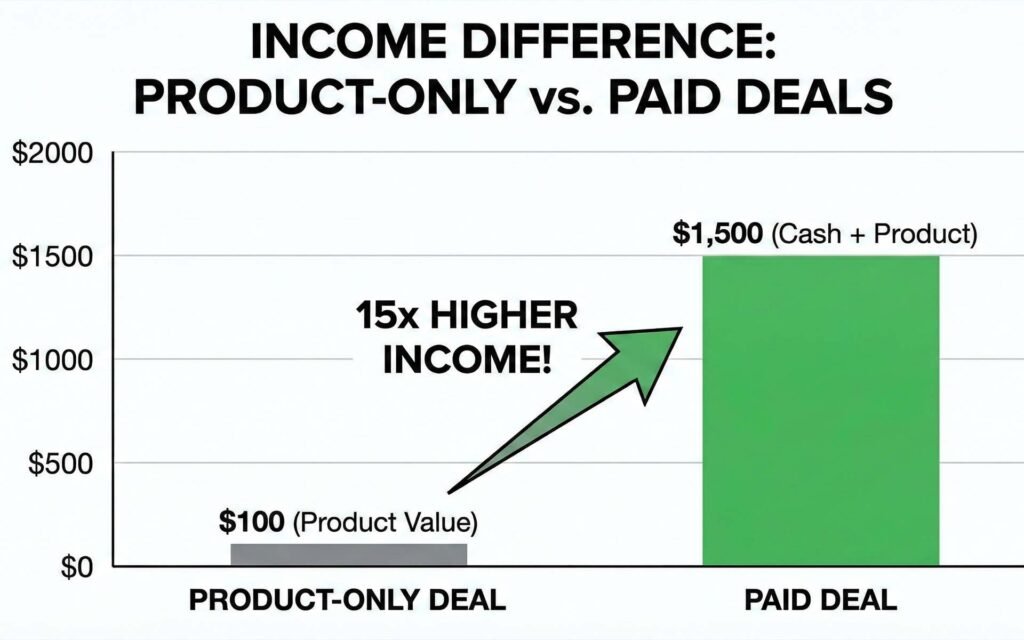
Free products do not pay the rent. Many brands will try to “pay” you with a sample of their product. Unless you are a brand-new channel with under 1,000 subscribers, you should be wary of these deals. You cannot pay your editor with a free pair of headphones.
When a brand offers “product-only,” they are asking for spec work. You are scripting, filming, editing, and lending your reputation to them for the cost of goods sold (COGS), which is often pennies on the dollar for them.
The Exceptions: When to Work for Free
However, rules are meant to be broken—strategically. You are a business owner, and sometimes a “loss leader” makes sense. You should only accept a product-only deal if it fits one of these three criteria:
- The “Dream Brand” Portfolio Piece: If Nike or Apple knocks on your door but has no budget (unlikely, but possible for small test campaigns), you might say yes just to put their logo on your media kit. Having a Tier-1 brand on your resume allows you to charge Tier-2 brands double the price later.
- High Affiliate Potential: If the product is something your audience is desperate for and the affiliate commission is high (20%+), the backend revenue might be worth more than a flat fee. In this case, negotiate for a higher commission rate instead of a flat fee.
- The “Audience Gift”: If the brand is willing to give you 10 free products to give away to your subscribers, the value isn’t cash—it’s community loyalty. Doing a giveaway can boost your engagement significantly.
If the deal doesn’t fit those three boxes, you need to pivot to a paid conversation.
The “Transition” Script: If a brand offers a free product, use this script to pivot to a paid conversation:
“Thanks so much for reaching out! I actually own [Product] already and love it, so I’m definitely familiar with the brand.
At this stage, my channel is fully scheduled for the quarter, so I’m prioritizing paid partnerships that allow me to invest more resources into production. I’d love to put together a professional package for you that guarantees a dedicated segment. Is there a budget available for creator activations this month?”
This script is polite but firm. It signals that you are a professional business, not a hobbyist.
Phase 2: The Art of Anchoring (Never Say Your Rate First)
The most common question creators get is: “What are your rates?”
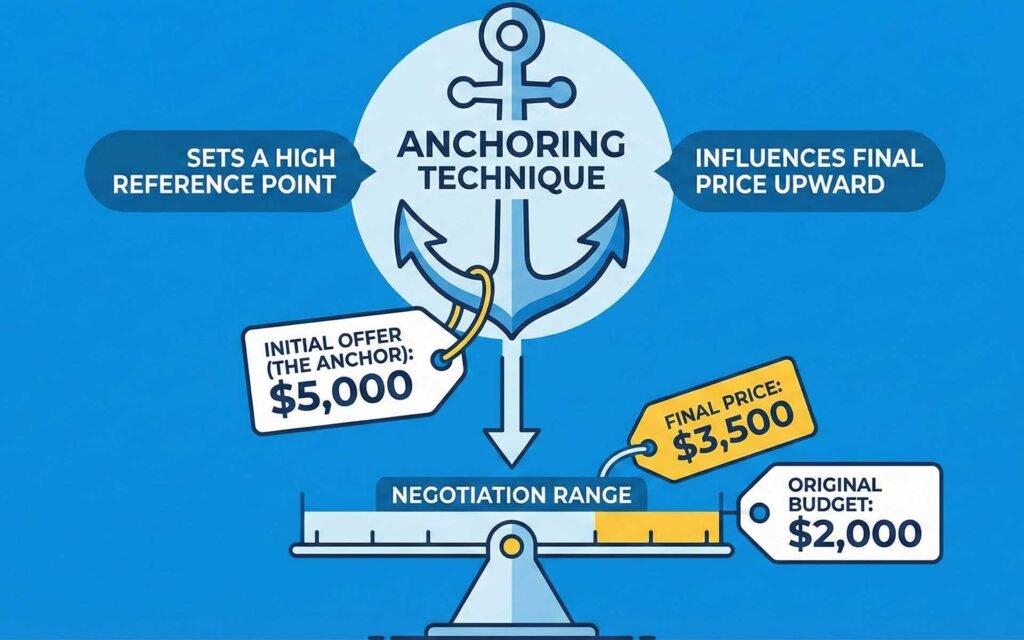
In any negotiation, the person who says a number first loses leverage. This concept is known as anchoring, a strategy often taught at Harvard Law School. If you say $500, but they had a budget of $2,000, you just lost $1,500 instantly.
Your goal is to get them to reveal their budget first, or to set an “Anchor” so high that your actual rate seems reasonable.
The “Reverse” Tactic
Instead of giving a number, ask for the scope.
“I’d love to give you a quote. To make sure I’m accurate, could you share what you’re looking to achieve? Are you looking for a dedicated video, a 60-second integration, or a bundle of YouTube Shorts? Also, what are the usage rights requirements?”
Setting the Anchor
If they force you to give a number, use Anchoring. This is a psychological bias where the first number mentioned sets the tone for the entire negotiation.
Do not give one number. Give a range, with the top number being painfully high.
“Typically, for a dedicated integration with these kinds of views, my partnerships range between $1,500 and $4,000, depending on the deliverables and usage rights.”
By saying “$4,000,” you have anchored them high. Now, if you agree on $2,000, they feel like they got a “deal,” even if you would have been happy with $1,000.
Phase 3: The “Good, Better, Best” Packaging Strategy
Never send a proposal with a single price. It forces the brand into a “Yes or No” decision. If the answer is No, the deal dies.
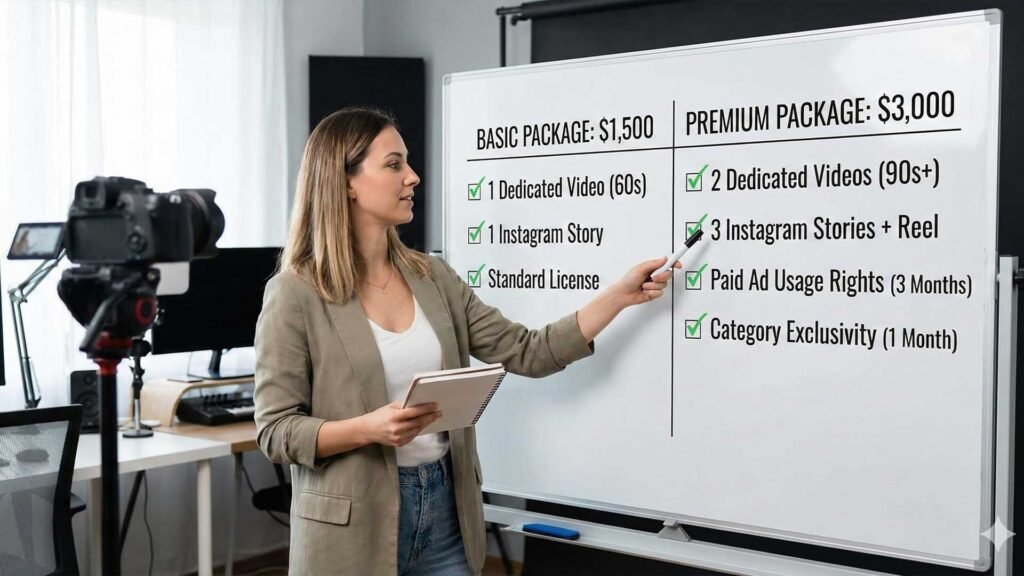
Instead, force them into a “Which one?” decision. This is called Tiered Pricing. You want to offer three packages.
Package A: The “Budget” (The Decoy)
This is the bare minimum. It includes exactly what they asked for and nothing else.
- Deliverable: 60-Second Integration.
- Price: $1,500.
Package B: The “Target” (What You Want)
This is the package you actually want them to pick. It adds slight value for a higher price.
- Deliverable: 60-Second Integration + 1 YouTube Short + Community Post.
- Price: $2,200.
Package C: The “VIP” (The Anchor)
This package is expensive and loaded with bells and whistles. Most won’t buy it, but it makes Package B look affordable.
- Deliverable: Dedicated Video + 3 Shorts + Newsletter Mention + 3 Months Usage Rights.
- Price: $4,500.
Why this works: When a brand sees Package C at $4,500, Package B at $2,200 looks like a steal. You effectively upsold them from the $1,500 they might have originally paid.
Phase 4: The Hidden Multipliers (Usage & Exclusivity)
This is where the pros make their real money. The “fee” for the video is just the base salary. The “Usage Rights” and “Exclusivity” are the bonuses.
1. Usage Rights (The 30-50% Multiplier)
Brands often want to take your video and run it as an ad on Facebook, Instagram, or TikTok. This is called Paid Media Usage.
If they do this, your face is being used in a commercial. You should be paid for that. Standard contracts often sneak this in for free (“in perpetuity”). Delete that clause immediately.
The Script:
“I noticed the contract includes ‘rights to use the content in paid advertising.’ My base rate covers organic usage on my channel only.
If you’d like to run the content as an ad (Whitelisting/Dark Posting), I charge an additional 30% of the base fee for 3 months of usage. Let me know if you want to add that in, or if we should remove that clause.”
2. Exclusivity (The “Opportunity Cost” Fee)
Brands will ask you not to work with their competitors. If a VPN company sponsors you, they might say, “You cannot work with other VPNs for 6 months.”
This restricts your income. If another VPN offers you a deal next month, you have to say no. Therefore, the first brand must pay for that lost opportunity.
The Script:
“I’m happy to offer exclusivity! Since this prevents me from accepting other opportunities in the [Category] sector, I charge a monthly exclusivity fee.
For a 3-month exclusivity period, the total would be [Base Rate + $X]. Alternatively, we can keep the rate as-is and remove the exclusivity clause so I remain open to other partners.”
Phase 5: Handling The “We Have No Budget” Objection
You will hear this often: “We love your channel, but we just don’t have the budget for that rate right now.”
Do not fold. Do not immediately drop your price. If you slash your price by 50% instantly, you look desperate, and they will trust you less. instead, remove value.
The “Strip-Mining” Script:
“I completely understand working within strict budget cycles. I really want to make this work.
To get closer to your number, we could remove the YouTube Short and the Community Post from the deliverables list. That would bring the rate down to $1,500. Does that work better for you?”
By removing deliverables, you maintain your value. You are saying, “My work is still expensive, you are just buying less of it.”
Phase 6: The “Walk Away” (The Ultimate Leverage)
Sometimes, a deal is just bad. A low-ball offer that requires huge effort is not an opportunity; it is a liability. It takes time away from making better videos or finding better sponsors.
If a brand refuses to pay a fair rate, refuses to remove usage rights, or is rude, you must be willing to walk away.
The “Polite Refusal” Script:
“Thank you for getting back to me. Based on the scope of work and the usage rights required, I won’t be able to move forward at that budget level.
I pride myself on high-quality production, and I can’t maintain that standard at this rate. If budgets open up in Q3 or Q4, please definitely reach out—I’d love to work together then!”
Warning: 20% of the time, this email makes them “magically” find the budget. The other 80% of the time, you dodged a bullet.
It’s Business, Not Personal
Negotiation can feel uncomfortable, but remember: you are a media company. Even if you are a one-man’s show.
NBC does not air commercials for free. Netflix does not give subscriptions away because you asked nicely.
Your content has value. Your audience has trust. Protect that value.
Start using these scripts today. Even if you only add 10% to your next deal, that adds up to thousands of dollars over a year.
Ready for the next step? Once you’ve secured the deal, you need to make sure the contract doesn’t trap you. Check out our next guide: The Creator Contract Checklist: Traps to Avoid Before Signing.
Follow YT Torials:

No responses yet