If you’ve noticed a sudden drop in revenue or received a “Repetitive Content” warning, you aren’t alone. In 2026, YouTube has significantly tightened the screws on how it defines and rewards “authenticity.” The platform is no longer just looking for copyright violations; it is hunting for “AI slop” and mass-produced automation that offers no real value to viewers.
This guide will break down exactly which channels are being targeted, how these changes affect your watch time, and what you must do to protect your income in this new era of creator-led content.
Table of Contents
- The 2026 Shift: From “Repetitious” to “Inauthentic”
- The “Slop” Case Study: Why Reddit Story Channels are Vanishing
- Repetitious vs. Reused Content: The Critical Difference
- Does Inauthentic Content Count Toward Your 4,000 Watch Hours?
- The Technical Side: How YouTube Spots “AI Slop”
- Safe vs. Unsafe AI Voices: Acoustic Variance Guidelines
- How to Stay Monetized: The “Human-in-the-Loop” Strategy
- Your “Appeal Video” Script: A Proven Template for Recovery
- Future-Proofing: Building Audience Security Beyond YouTube
- Conclusion & Next Steps
The 2026 Shift: From “Repetitious” to “Inauthentic”
YouTube recently renamed its “Repetitious Content” policy to Inauthentic Content. While the name change seems small, the enforcement is massive. Consequently, the platform is moving away from just checking if you uploaded the same video twice. Now, they are looking at the soul of your channel.
In the past, you could get away with using a basic script-to-video tool. You would paste a blog post, let an AI voice read it, and put stock footage behind it. However, in 2026, YouTube views this as “mass-produced” content. If a viewer feels like they are watching a machine rather than a person, YouTube will likely pull the plug on your ads.
The “Slop” Case Study: Why Reddit Story Channels are Vanishing
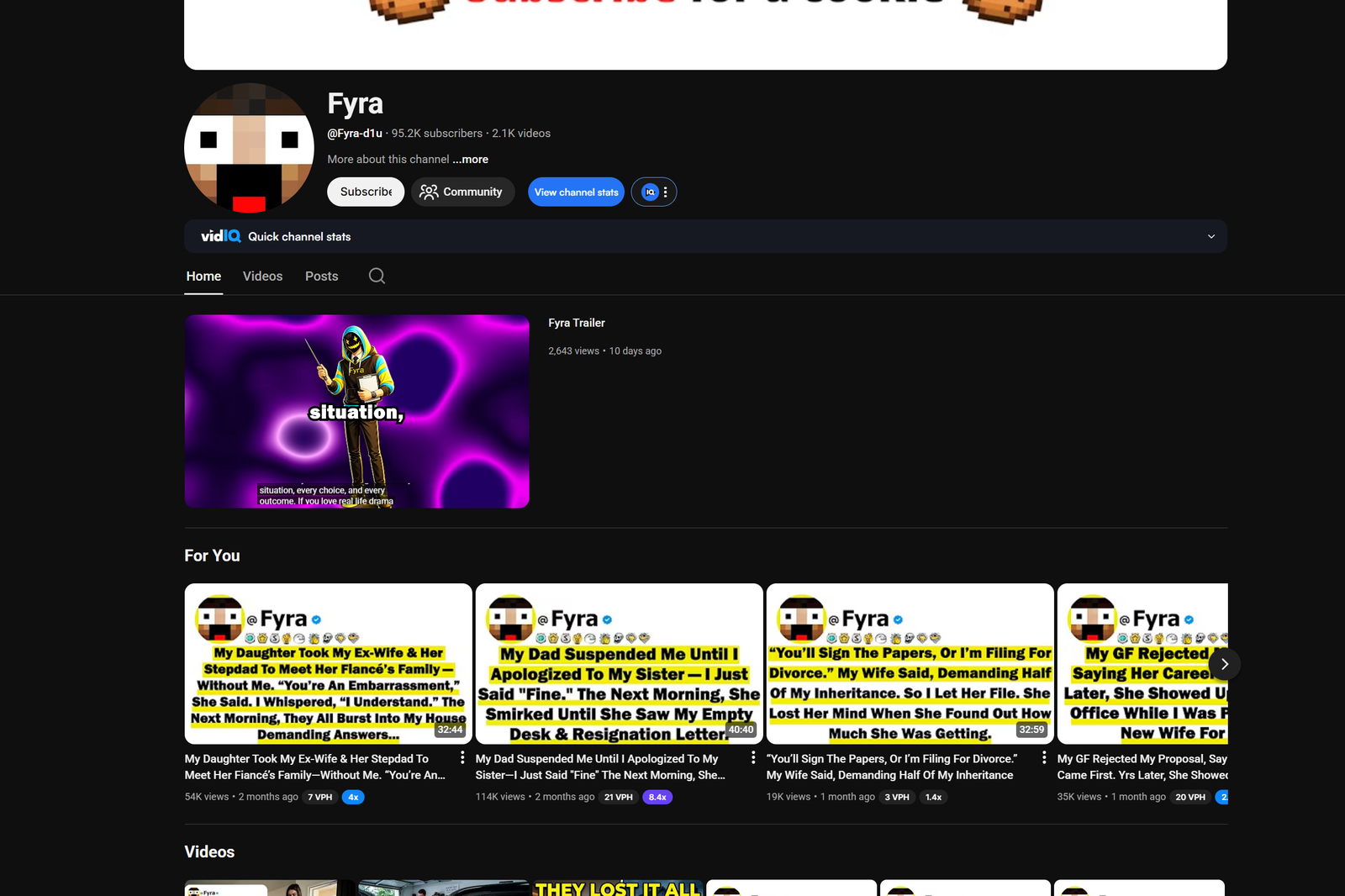
To truly understand the 2026 crackdown, we have to look at the rise and fall of “Reddit Story” automation. For years, channels like Fyra or various “Am I The Jerk?” clones dominated the algorithm.
The Formula
Their formula is remarkably simple and highly scalable: scrape a popular Reddit thread, use an AI voice (often the generic “deep-male” ElevenLabs tone), and overlay Minecraft parkour or GTA stunt footage that was downloaded from a free asset pack. A creator could make 10 of these videos a day with almost zero creative input.
With AI, I doubt most of these channels are even getting actual stories from Reddit when they can just make their own with the help of ChatGPT or any other AI assistant available.
Why YouTube Nuked Them
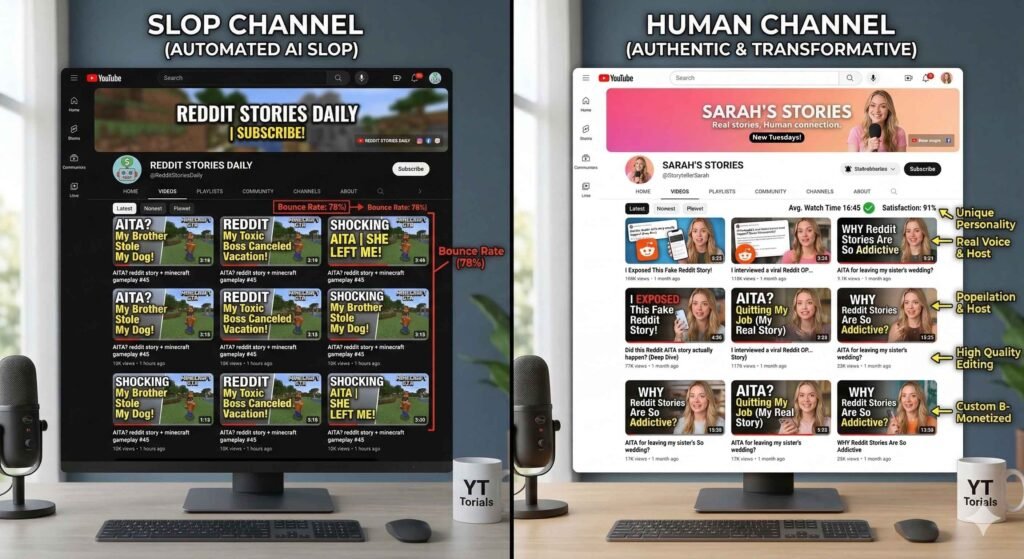
YouTube didn’t demonetize these channels because they used AI; they demonetized them because they were interchangeable.
- The Brand Suitability Nightmare: Advertisers do not want their premium ads running on low-effort “slop” that viewers only watch as background noise. Advertisers require unique, high-value contexts.
- Viewer Dissatisfaction Scores: When viewers see the same Minecraft parkour background loop on 50 different channels, they eventually stop clicking. YouTube’s algorithm prioritizes “Viewer Satisfaction” scores. When dissatisfaction is high, YouTube buries the content niche.
- The Metadata Problem: Often, these automated channels use copied or slightly altered descriptions, which further triggers the “mass-produced” algorithm flag. If you are struggling with unique metadata, check out our guide on how to optimize YouTube descriptions for help.
Comparison: The “Slop” Metric vs. the “Human” Metric
Repetitious vs. Reused Content: The Critical Difference
Many creators confuse these two terms. Understanding the difference is vital for your appeal process.
1. Reused Content
This happens when you take someone else’s work and upload it. For example, taking clips from a Netflix show or another YouTuber. You can only monetize this if you transform it. This means adding a lot of commentary, funny edits, or a unique perspective.
2. Inauthentic (Repetitious) Content
This is your own content, but it’s too similar across the channel. If every video uses the same intro, the same background music, and follows a strict template with no variety, it gets flagged. Specifically, YouTube wants to see that each video offers something new.
For more on how to stand out and avoid these traps, check out our guide on how to go viral on YouTube without sacrificing quality.
Does Inauthentic Content Count Toward Your 4,000 Watch Hours?
This is the question every new creator asks. The short answer is: Maybe, but it won’t help you get approved.
When you apply for the YouTube Partner Program (YPP), you need 1,000 subscribers and 4,000 watch hours. However, those hours must be “valid public watch hours.” If YouTube’s AI determines your content is “inauthentic” or “low-value” during the review process, they can disqualify those hours.
- The Review Process: Once you hit your 4k hours, a human reviewer looks at your channel.
- The Verdict: If they see your hours came from mass-produced AI videos, they will reject your application.
- The Penalty: You may have to wait 30 to 90 days to re-apply.
Furthermore, YouTube is now using “Engagement Quality” metrics. If people are clicking away from your “slop” videos after 10 seconds, the algorithm learns that your content isn’t worth showing. This effectively kills your organic reach before you even hit the monetization threshold.
The Technical Side: How YouTube Spots “AI Slop”
YouTube has invested billions into detection tools. In 2026, they use systems like SynthID and C2PA (Content Provenance and Authenticity). These tools can tell if a voice is synthetic or if an image was generated by an AI model.
- Digital Watermarking: Even if you can’t see it, AI-generated files often have metadata that identifies them as non-human.
- Pattern Recognition: YouTube’s AI looks for “template-style” editing. If your transitions always happen at the 5-second mark and use the same stock assets, you’ll be flagged.
- Likeness Detection: A new 2026 update allows creators to report AI that mimics their voice or face, making “cloned” content even harder to monetize.
To stay safe, you should always check the official YouTube Channel Monetization Policies for the most recent updates on advertiser-friendly content.
Safe vs. Unsafe AI Voices: Acoustic Variance Guidelines
Many automated channels rely exclusively on synthetic narration. YouTube isn’t banning synthetic voices, but they are banning acoustic monotony.
What Are “Unsafe” Voices?
“Unsafe” voices are the cheap or free text-to-speech (TTS) models that offer no emotional inflection, pausing, or natural variance. Specifically, the “Fyra male” tone is now flagged because it lacks acoustic variance—the naturally occurring shifts in pitch and volume that prove a real voice box produced the sound. If the waveform of your voiceover looks like a flat brick, you are at risk.
What Are “Safe” Voices?
“Safe” synthetic voices are high-quality, cloned models that use advanced prosody algorithms to inject emotion and natural speech patterns. You can use these, but you must be the primary voice source. For example, cloning your own voice and then heavily editing the timing, pitch shifts, and dramatic pauses is a safe approach. This adds the necessary “Human-in-the-Loop” validation.
<a name=”strategy”></a>
How to Stay Monetized: The “Human-in-the-Loop” Strategy
You can still use AI tools, but you must be the “Director,” not just the “User.” Here is how to keep your channel safe in 2026:
- Use Your Real Voice: If you must use TTS, choose high-quality “cloned” versions of your own voice or heavily edit the pacing.
- Add Face-to-Camera segments: Even a 30-second intro with your actual face can prove to YouTube that a human is behind the channel.
- Unique Scripting: Never copy and paste from Reddit or ChatGPT. Use AI to outline, but write the final script yourself to add humor and personal stories.
- Custom Visuals: Instead of just using Minecraft parkour, record your own gameplay, use a face-cam overlay, or color-grade standard stock footage to make it your own.
Your “Appeal Video” Script: A Proven Template for Recovery
If you are demonetized for “Inauthentic Content,” do not panic. Your single best chance is the Appeal Video. Most creators fail here because they send an emotional video begging for revenue. The reviewers do not care about your feelings; they care about compliance.
You have 5 minutes to prove you are a unique, professional creator.
The Proven 10/10 Appeal Script Template:
- (0:00-0:30) Introduction & Identity Verification: “Hello YouTube Team, I am [Your Name], the owner and primary creator for [Channel Name]. My channel ID is [Your Channel ID]. I am making this video to appeal the decision regarding ‘Inauthentic Content’.” Crucial: You must show your face and state your ID.
- (0:30-2:00) Proof of Original Process (Screen Recording): Start your screen recording showing your editing software (e.g., Premiere Pro, Resolve, CapCut). “I want to walk you through my actual workflow. For every video, I start by writing a unique script based on my personal research into [Subject].” Show your script document and highlight original sections. “I then use AI as a tool to refine the pitch, not generate the content.”
- (2:00-4:00) Proof of Human Editing (Project Breakdown): Show your actual editing timeline. “Here you can see the project file for my latest video. Look at the complex layering. I have over 50 unique B-roll clips that I curated myself, custom text overlays, and specialized color grading.” Show the nested sequences. “I spend an average of 10 hours editing each video. If this were automated slop, my timeline would be one simple audio track and one looping video track. This complexity proves human effort.”
- (4:00-4:30) Value Proposition: “My channel provides educational value by [Explain your purpose, e.g., breaking down financial concepts or offering psychological insights]. I do not simply re-upload content; I synthesize new ideas for my community.”
- (4:30-End) Closing Commitment: “I am committed to building a compliant, creator-led business on YouTube. I hope you will review this information and restore my monetization so I can continue to invest in high-quality content for my 10,000 viewers. Thank you for your time.”
Following this script demonstrates professionalism and compliance, making it much easier for a human reviewer to reverse the automatic flag.
Future-Proofing: Building Audience Security Beyond YouTube
If you rely 100% on ad revenue from a single platform, you are building your business on a fault line. The 2026 purge taught us that policies can change overnight. To truly achieve security, you must own your audience.
- Own Your Data: Build an email list immediately. If YouTube deletes your channel tomorrow, you still have a direct line to your most loyal viewers. Offer a free guide, an exclusive checklist, or a “behind-the-scenes” video as an incentive to join.
- Build a Community Hub: Create a Discord server or a dedicated community forum. This gives your audience a place to interact independently of your video uploads, building brand loyalty that can survive algorithm shifts.
- Diversify Revenue Streams: Don’t rely purely on the “green dollar sign.” Explore affiliate marketing, selling digital products (like editing assets or e-books), or launching a merchandise line. By having multiple income sources, a demonetization event becomes a “bump in the road” rather than a financial catastrophe.
Conclusion & Next Steps
YouTube is no longer a place where you can “set it and forget it” with automation. In 2026, the platform demands authenticity. While “AI slop” might get you some initial views, it will eventually lead to demonetization and a dead channel. By focusing on “human-in-the-loop” content, unique prosody in your audio, and diversified distribution, you protect your watch time and your revenue for the long haul.
Want more tips on staying ahead of the algorithm? Subscribe to the YT Torials newsletter for weekly deep dives into YouTube policy. Also, don’t forget to follow our YouTube channel YT Torials for video guides on how to grow your brand the right way!
Follow YT Torials:
Sign up to the YT Torials Newsletter


No responses yet