The internet is a massive, sprawling city. For adults, it is a place of endless information and entertainment. But you would not drop a five-year-old off in the middle of Times Square alone. You would take them to a fenced-in playground. That is exactly what the YouTube Kids app is designed to be.
Unlike the main YouTube platform, which is an open library of nearly everything uploaded to the internet, YouTube Kids is a filtered, curated experience. It is a separate app designed specifically to be a safer, simpler place for children to explore their interests. However, creating a “safe” space is not as simple as just blocking bad words. YouTube has developed a complex set of policies, content settings, and commercial restrictions to ensure the environment is not just “not scary,” but actually enriching.
Whether you are a parent trying to understand what your child is watching, or a creator looking to break into the massive children’s entertainment market, you need to understand the rules of this playground. In this deep dive, we will explore how YouTube Kids works, the specific content tiers, and the strict rules against commercialism that every creator must follow in 2026.
Table of Contents
- What Makes YouTube Kids Different?
- The 3 Content Settings: Tailoring the Experience
- The Commercial Content Crackdown
- Quality Principles: What Actually Gets Approved?
- The Creator’s Dilemma: How to Adapt
- Parental Controls: The Final Safety Net
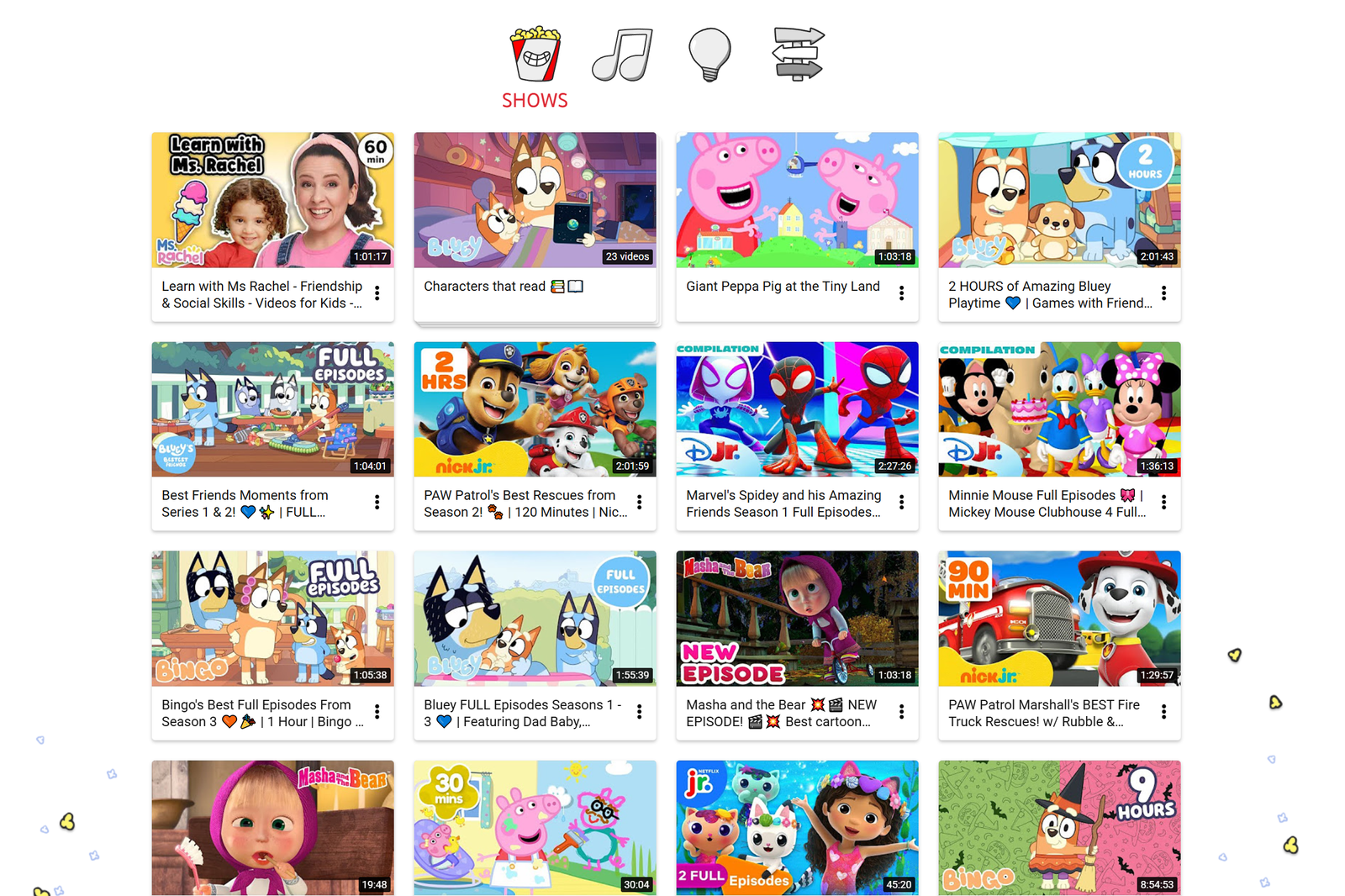
What Makes YouTube Kids Different?
The main YouTube app and website are designed for users over the age of 13. While there are “Restricted Modes” on the main app, it is still an open platform. YouTube Kids is fundamentally different because it operates on a whitelisting philosophy rather than just a blacklisting one.
This means that instead of just trying to filter out the “bad stuff,” YouTube actively looks for content that meets specific quality principles. The content available on the app is a fraction of what is on main YouTube. To make the cut, videos must be:
- Age-Appropriate: Tailored to specific developmental stages.
- High Quality: Adhering to principles of education, diversity, and inclusion.
- Non-Violative: Strictly following YouTube Community Guidelines as a baseline, but with even stricter standards.
This curation process uses a mix of automated filters (AI) and human review. While no system is perfect, this dual-layer approach is designed to catch things that might slip through a simple keyword filter. In 2026, the FTC has also pushed for better age verification, making these filters even more robust for families everywhere.
The 3 Content Settings: Tailoring the Experience
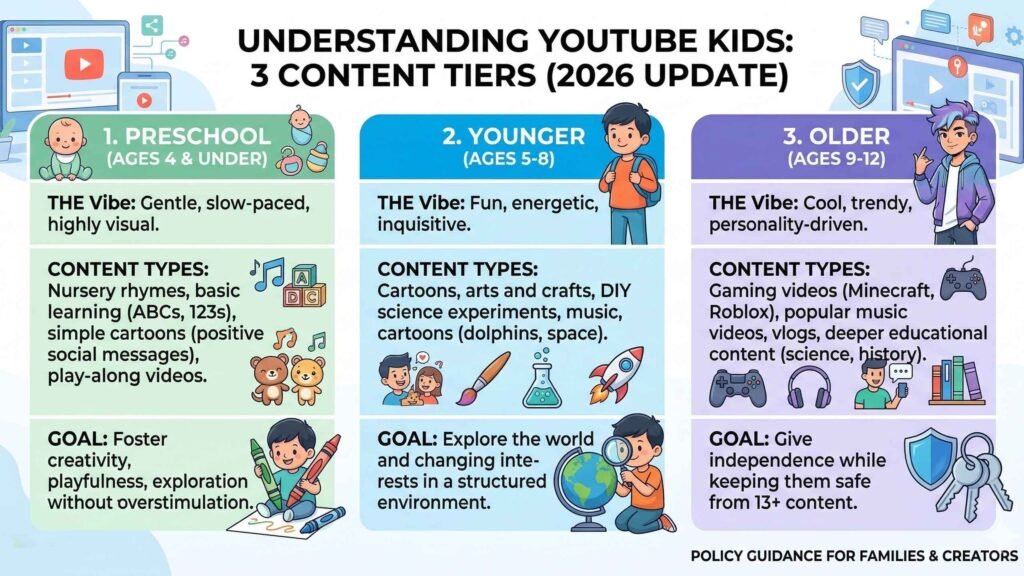
Children grow fast. A four-year-old and an eleven-year-old are basically different species when it comes to what they enjoy. To address this, YouTube Kids offers three distinct Content Settings. When a parent sets up the app, they choose the setting that matches their child’s age. This determines what appears in the feed and search results.
1. Preschool (Ages 4 and Under)
This is the most protective setting. It is designed for toddlers and pre-k children who are just starting to interact with screens.
- The Vibe: Gentle, slow-paced, and highly visual.
- Content Types: Nursery rhymes, basic learning (ABCs, 123s), and simple cartoons.
- Goal: To foster creativity and early exploration without overstimulation.
2. Younger (Ages 5-8)
As kids enter elementary school, their interests expand. They stop watching “Baby Shark” and start getting interested in characters and hobbies.
- The Vibe: Fun, energetic, and inquisitive.
- Content Types: Arts and crafts, DIY science experiments, and cartoons.
- Goal: To allow kids to explore the world in a structured environment.
3. Older (Ages 9-12)
This is the bridge between the kids’ app and the main app. These “tweens” want content that feels more mature but is still safe.
- The Vibe: Cool, trendy, and personality-driven.
- Content Types: Gaming videos (like Minecraft or Roblox), music videos, and vlogs.
- Goal: To give older kids independence while staying away from 13+ content.
The Commercial Content Crackdown
This is the most critical section for creators and parents alike. For years, YouTube was flooded with “toy channels.” These were 10-minute commercials disguised as entertainment—kids unboxing toys and screaming in delight.
Because of this, child development experts at Common Sense Media argue that young children cannot distinguish between entertainment and advertising. Consequently, YouTube Kids has implemented extremely strict Commercial Content Policies.
No Paid Product Placements
This is a hard line in the sand.
- The Rule: You cannot upload a video to YouTube Kids that includes a paid endorsement.
- The Enforcement: If a creator checks the “This video contains paid promotion” box, that video is automatically removed from the YouTube Kids app. It will stay on main YouTube but will never reach the kids’ audience.
The Ban on “Overly Commercial” Content
Even if a brand did not pay the creator, the video itself cannot be a commercial. YouTube restricts content that promotes “excessive consumerism.” Here is what is banned:
- Traditional Ads: You cannot upload a TV commercial for a toy as a video.
- Direct “Buy This” Messaging: Content that encourages buying a product is not allowed.
- Packaging Focus: Videos that focus entirely on packaging rather than a story or activity.
- Excessive Accumulation: This targets “haul” videos where a child is buried in 500 new toys.
Quality Principles: What Actually Gets Approved?
If you cannot sell stuff and you cannot be scary, what can you do? YouTube measures content against specific Quality Principles. Therefore, if you want to succeed on the platform, you must look for these pillars:
- Enrichment: Does the video teach something? This can be social skills, curiosity, or emotional intelligence.
- Interaction: Does the video encourage the child to look away from the screen? For example, think of “yoga for kids” or “draw along” videos.
- Diversity: Does the content show different types of people, cultures, and family structures?
- Character: Are the role models in the video positive? Do they solve conflicts with words or kindness rather than aggression?
If a channel consistently violates these principles—even if they do not break the “safety” rules—they may be removed from the Kids app for being “Low Quality.”
The Creator’s Dilemma: How to Adapt
If you are a creator reading this, you might be sweating. The YouTube Kids policies are restrictive. However, they are also an opportunity. To survive in this ecosystem, you have to pivot your YouTube branding strategy.
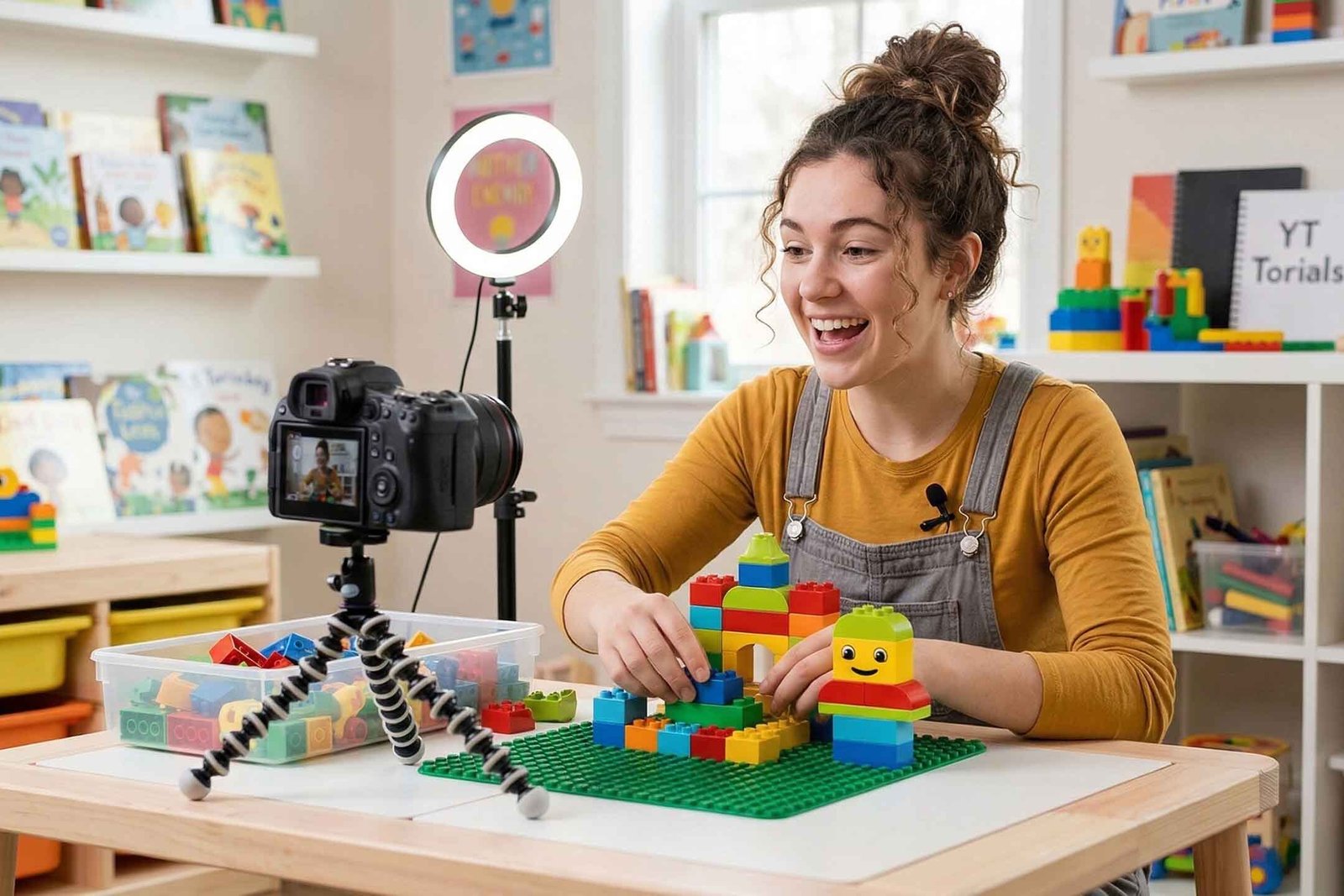
- Shift from “Unboxing” to “Storytelling”: Do not just open a box of LEGOs. Build a world with them. Tell a story where the figures have to solve a problem. Focus on creativity.
- Focus on Personality: Since you cannot rely on “shock value,” your personality is everything. The most successful creators feel like a trusted big brother, sister, or teacher.
- Monetization Changes: Since you cannot run targeted ads on “Made for Kids” content due to COPPA laws, revenue can be lower. Creators often rely on merchandise sold off-platform, licensing to TV, or memberships for parents.
Parental Controls: The Final Safety Net
Despite all these filters, YouTube admits that no system is perfect. Instead, the app puts the final control in the hands of the parents.
- Blocking Content: If a parent sees a channel they do not like, they can block it. That channel will never appear in that profile again.
- Search Control: Parents can turn Search OFF. This restricts the child to only watching channels verified by YouTube.
- Approved Content Only: For the ultimate “walled garden,” parents can hand-pick every video, channel, or collection their child can see.
Summary
The YouTube Kids app is a fascinating experiment in digital safety. It attempts to take the chaotic nature of the internet and distill it into something safe, educational, and fun. For parents, it offers peace of mind through Preschool, Younger, and Older settings. For creators, it offers a massive audience but requires a deep commitment to quality and a rejection of “easy” commercial content. The internet will never be 100% safe, but by understanding these policies, we can ensure our youngest digital citizens have a space to grow.
Want to keep your family or your channel safe? Understanding digital policies is just the first step. Subscribe to the YT Torials newsletter below and follow my YouTube channel YT Torials for weekly updates on platform safety and algorithm changes.
Related Posts
Online Defamation – The Dangerous Myth of “Allegedly”
A Complete Guide to YouTube’s Deceptive and Spam Policies
Fake Engagement Policy: How to Protect Your Channel
The End of AI Slop: New Inauthentic Content Rules
How to Stay Anonymous Online: Ultimate Digital Privacy Tips
The NO FAKES Act: A New Shield for Creators
YouTube Playlist Policy: How to Avoid Problems

No responses yet